Get a quoate
What Is a Portable Clean Room? Definition, Features & How It Works
Published : 2026-01-04Composition and Working Principle of Portable Cleanrooms
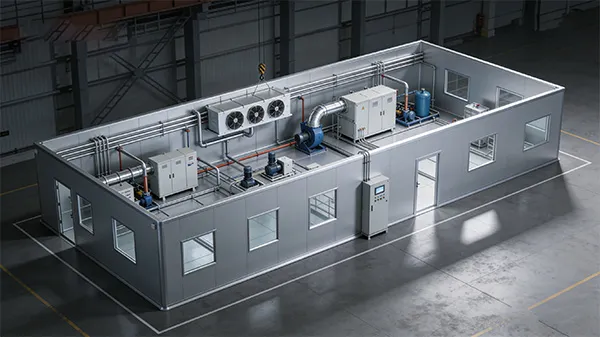
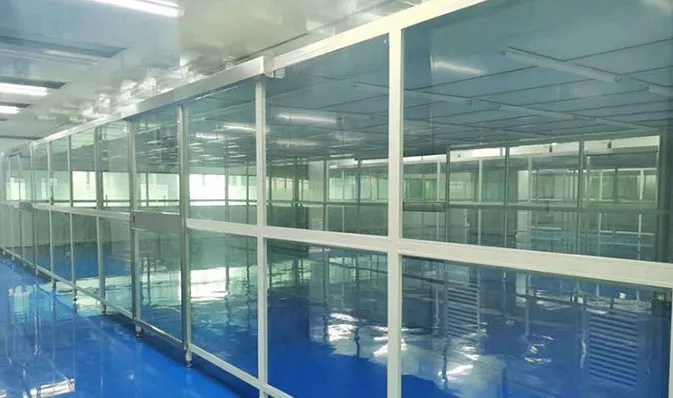
Core Structure A portable cleanroom consists of an industrial-grade aluminum profile or stainless steel frame as the main support structure. At its power core is the Fan Filter Unit (FFU), while the perimeter is flexibly sealed with anti-static (ESD) curtains or tempered glass to create a localized, enclosed purification space.
- FFU (Fan Filter Unit): Integrates a low-vibration external rotor centrifugal fan with a dual-stage filtration system (Primary + HEPA), achieving continuous air circulation and purification.
- Cleanliness Levels: Based on the ISO 14644-1 standard, these units can achieve localized purification from ISO Class 5 (Class 100) to ISO Class 8 (Class 100,000), meeting the requirements of low-to-medium risk scenarios such as electronic assembly and pharmaceutical dispensing.
Operating Principle The FFU draws in ambient air from the top. After passing through multi-stage filtration, the air is delivered vertically downward in a laminar flow pattern. This creates a stable “airflow curtain” that continuously pushes particles and dust within the operating zone toward the bottom exhaust area. This mechanism achieves a high-cleanliness local environment without requiring a full-room renovation.
Common FAQs and Authoritative Answers
Q1: Can a portable cleanroom replace a traditional fixed cleanroom?
A: No. Portable cleanrooms are only suitable for localized, temporary, or non-critical process areas, such as SMT mounting zones, dispensing benches, and inspection stations. Their airflow control range is limited and cannot meet systemic requirements such as full-room constant temperature and humidity, precise pressure gradients, personnel gowning buffers, or integrated equipment linkage controls. Traditional cleanrooms are essential for high-risk, continuous production scenarios like semiconductor manufacturing and sterile filling. The two are complementary, not substitutes for one another.
Q2: Can it be used for sterile surgeries?
A: Absolutely not. Sterile surgery requires dynamic cleanliness of ISO Class 5 or higher and must comply with GMP Grade A standards. This requires continuous airflow, fully enclosed personnel operations, and strict microbial sedimentation control (≤5 cfu/m³). A portable cleanroom cannot guarantee core surgical theater elements such as sustained differential pressure, sterile material transfer, or personnel movement isolation. It is suitable only for Level IV environments, such as nucleic acid sampling kiosks or isolated observation chambers.
Core Advantages of Implementing Portable Cleanrooms
| Benefit Dimensions | Key Advantages | Industry Basis |
| Deployment Efficiency | Installation and commissioning completed within 72 hours, no civil construction required, supports rapid response to production line changes | Reduces construction time by 80% compared to traditional cleanrooms |
| Cost Savings | Initial investment is only 1/5–1/3 of fixed cleanrooms, with operational energy consumption reduced by over 30% | Case Study: Electronics Factory Single portable cleanroom saves approximately ¥42,000 in annual electricity costs |
| Flexibility | Modular design enables disassembly, reconfiguration, and relocation for multi-line reuse | Environmental Technology Company: A single unit rotates across three production lines, boosting annual utilization by 210% |
| Compliance Adaptation | Supports IQ/OQ/PQ validation per ISO 14644-2, meeting GMP, FDA, CE, and other certification requirements | Group products certified by CMA for compliance validation in pharmaceutical filling lines |
| Environmentally Sustainable | Utilizes washable electrostatic filter media, reducing HEPA filter replacement frequency and minimizing solid waste generation | Ultra-micro electrostatic technology replaces traditional medium-efficiency filters, reducing annual filter material waste by over 80% |
Standardized Process from Installation to Acceptance
Based on ISO 14644-2 and GMP validation specifications, portable cleanroom implementation follows a five-step process:
1. Site Preparation and Measurement
- Clear the Installation Area: Ensure the floor is level and free of debris.
- Precision Measurement: Use a laser rangefinder to measure the spatial dimensions. Confirm the frame installation boundaries and the layout of FFU (Fan Filter Unit) positions, ensuring a maintenance clearance of ≥0.5m around the unit.
2. Frame Assembly and Sealing
- Modular Assembly: Assemble the aluminum profile frame according to the modular blueprints using specialized fasteners/clips.
- Enclosure and Sealing: Install anti-static (ESD) curtains or tempered glass panels. Apply cleanroom-grade neutral silicone sealant at joints to ensure airtightness, targeting a leakage rate of ≤0.1%.
3. FFU Installation and Power Connection
- Array Installation: Mount the FFU units onto the ceiling grid in the designed array, ensuring reliable connections between each FFU, the power supply, and the control modules.
- Operational Check: Verify the fan rotation direction and the three-speed control function. Confirm there is no abnormal vibration or noise.
4. Differential Pressure and Airflow Debugging
- Pressure Monitoring: Use a micro-manometer (differential pressure gauge) to measure the pressure difference between the clean zone and the external environment. Adjust the FFU operating frequency to stabilize the differential pressure at +5 to +15 Pa.
- Airflow Verification: Use an anemometer to detect the face velocity at the air outlet. Ensure that unidirectional flow (laminar) zones achieve ≥0.35m/s, and non-unidirectional flow zones achieve an air change rate (ACR) of ≥20 times/hour.
5. Cleanliness Verification and Acceptance
- Particle Sampling: Use a laser particle counter to perform three-point sampling at a height of 0.8m above the floor to detect concentrations of particles ≥0.5μm.
- ISO Classification: Determine the cleanliness class per ISO 14644-1. For example, if the concentration remains ≤3,520 particles/m³, it qualifies as ISO Class 5.
- Microbiological and Acoustic Testing: Simultaneously test for settleable microbes (≤1 cfu/4h per Φ90 dish) and noise levels (≤65dB). Issue the final Validation Report.
Real-World Application Cases Worldwide(Click for More Case Studies)
| Company Name | Application Scenario | Cleanliness Grade | Implementation Results |
| Research Lab in Saudi Arabia | Temporary filling area for biosafety cabinet R&D lab | ISO Class 5 (Class 100) | Successfully replaced temporary retrofitting projects, achieved 100% cleanliness compliance rate, reduced deployment time from 15 days to 3 days |
| Malaysian Semiconductor Packaging Plant | Localized purification for SMT placement machine workstations | ISO Class 7 (Class 10,000) | Product yield increased by 12%, solder joint defects caused by dust reduced by 87%, annual rework cost savings of approximately ¥380,000 |
| Dubai Pharmaceutical Company | Temporary Expansion Zone for Penicillin Filling Line | ISO Class 8 (Class 100,000) | Added 2 new filling lines without expanding facilities, achieving 90% equipment reuse rate and reducing unit production capacity construction costs by 65% |
Whether you need to quickly set up a temporary clean space or seek a cost-effective alternative to traditional cleanrooms, Boben Modular Cleanroom Manufacturer provides efficient, flexible, and reliable portable clean solutions. Leveraging years of international trade experience and robust technical expertise, Boben is committed to becoming a trusted clean space partner for global customers.
Contact Boben Modular Cleanroom Manufacturer today for a customized solution and precise quotation!