Get a quoate
What is a Modular Clean Booth? Understanding the Differences Between ISO Classes
Published : 2026-03-26When you need to upgrade the cleanliness of a specific production line, building a full-scale, permanent cleanroom is often overkill—both in terms of time and budget. This is where the Modular Clean Booth (often called a “room-within-a-room”) comes into play. It’s the industry’s favorite “shortcut” to achieving high-purity environments exactly where they’re needed, without the headaches of traditional construction.
But what exactly makes one booth different from another? And how do you decide which cleanliness tier is right for your facility? Let’s break it down from a practical, engineering perspective.
What Exactly is a Clean Booth?
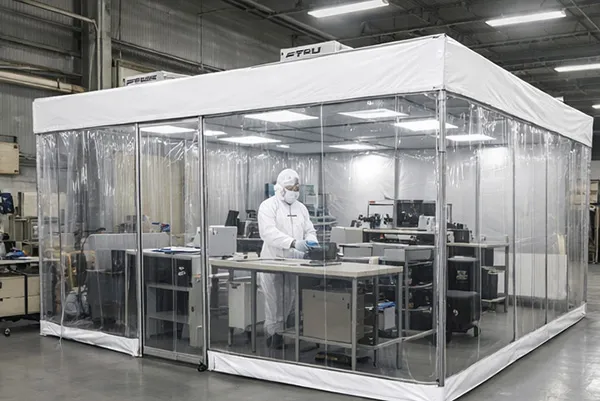
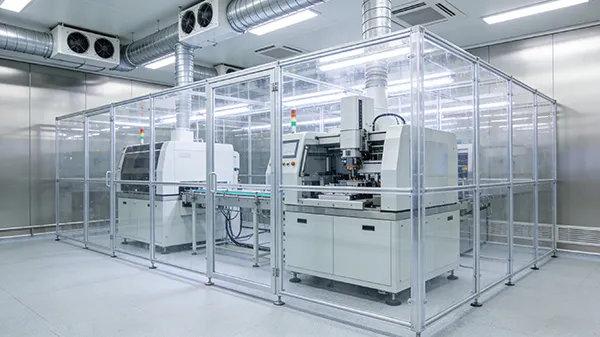
At its core, a clean booth is a prefabricated, localized purification unit. Instead of scrubbing the air for an entire warehouse, it focuses all its “heavy-lifting” on a specific workstation.
The beauty of the modular approach lies in its elasticity. Whether you need it suspended from the ceiling to save floor space or supported on heavy-duty casters for mobility, the design adapts to your shop floor, not the other way around. It’s built using a high-strength frame (usually aluminum or stainless steel), integrated Fan Filter Units (FFUs), and anti-static PVC curtains that keep the “clean” air in and the “dirty” air out.
The Mechanics: How the Air Stays Pure
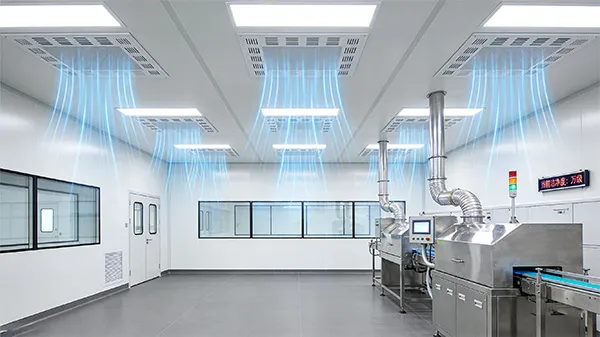
The magic happens via Vertical Laminar Flow. The FFU units mounted on the ceiling pull ambient air through a pre-filter, then force it through a HEPA or ULPA filter. This “scrubbed” air is pushed downward in a steady, unidirectional stream. This constant downward pressure creates a “piston effect” that sweeps contaminants toward the floor and out through the bottom gaps, ensuring that your work zone stays pristine 24/7.
Decoding the Tiers: From Class 100 to 100,000
Cleanliness isn’t “one size fits all.” Depending on your industry, the difference between Class 100 and Class 10,000 can be the difference between a successful batch and a total product loss.
1.The “Ultra-Precision” Tier (Class 100 / ISO 5)
This is the gold standard for high-stakes environments. A Class 100 booth is engineered for zero-compromise scenarios. It features a higher density of FFUs to ensure a strictly controlled vertical airflow and often includes dedicated air return systems to minimize turbulence.
- Best For: Semiconductor lithography, sterile medical filling, and high-end optical bonding.
2.The “Performance” Tier (Class 1,000 / ISO 6)
A step down in density but still incredibly high-performing. These booths typically use robust SUS304 or powder-coated steel frames and are the workhorses of the electronics industry. They provide a stable, controlled environment that is easy to maintain.
- Best For: High-end electronics assembly and advanced laboratory R&D.
3.The “Standard Industrial” Tier (Class 10,000 to 100,000 / ISO 7-8)
These booths focus on cost-efficiency and localized protection. Often powered by centrifugal FFUs to keep noise and vibration to a minimum, they are perfect for shielding specific parts of a long assembly line from factory dust.
- Best For: Precision machining, food packaging, and general electronics production lines.
Choosing the Right Setup: A Quick Guide
How do you determine which level of isolation you actually need? It usually comes down to the sensitivity of your product:
- ISO 5 (Class 100): If even a 0.5-micron particle can ruin your yield (think microchips or injectable drugs), this is your only option.
- ISO 6-7 (Class 1,000 – 10,000): This is the sweet spot for most precision assembly tasks where general dust control is the goal, but “absolute” sterility isn’t required.
- ISO 8 (Class 100,000): Perfect for meeting basic regulatory standards for food or general industrial packaging.
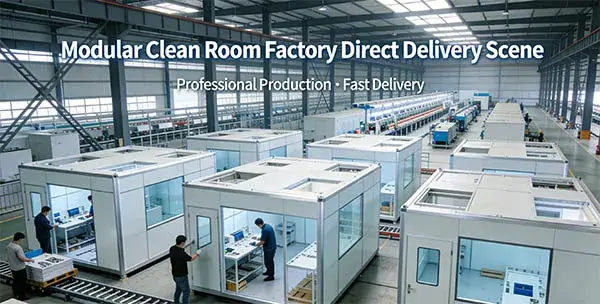
The modular clean booth is about scalability. You can start with a single standalone unit and connect others as your production grows. It’s a turnkey solution that respects both your timeline and your bottom line.
Ready to spec out your own modular environment? At Boben, we specialize in tailoring these “rooms-within-a-room” to fit your exact floor plan and ISO requirements. Whether you need the mobility of a portable pod or the rigidity of a hardwall system, we can get you operational in a fraction of the time a traditional build would take.