Get a quoate
What is a Class 10,000 Cleanroom? A Guide to ISO 7 Standards
Published : 2026-03-26“Class 10,000 cleanliness,” simply put, refers to an environment where the number of dust particles with a diameter of 0.5 microns or larger does not exceed 10,000 per cubic foot of air. When converted to cubic meters, this corresponds to a limit of 352,000 particles.
The term “Class 10,000” originates from the U.S. Federal Standard FS 209E. Although this standard has been officially abolished and replaced by the new international standard ISO 14644-1, the industry habitually continues to use the legacy terminology. “Class 10,000” in the old standard generally corresponds to ISO Class 7 in the new standard.
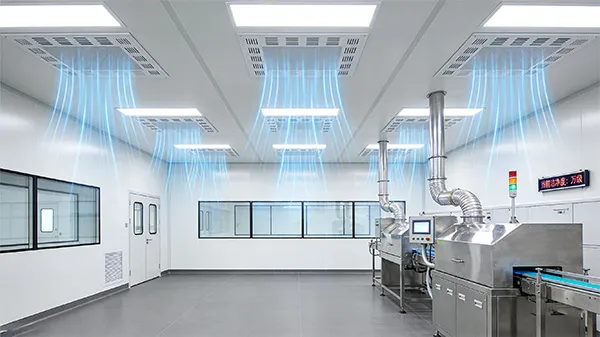
It occupies a mid-range position in cleanliness classifications, situated between “Class 1,000” (ISO 6) and “Class 100,000” (ISO 8). Generally, maintaining Class 10,000 cleanliness requires continuous air circulation and filtration through high-efficiency systems (comprising primary, medium, and HEPA filters), alongside strict control of temperature, humidity, and airflow.
Core Technical Indicators:
- Dust Particles: ≤ 0.5 μm: ≥ 352,000 particles/m³ , ≥ 5 μm: ≤ 2,930 particles/m³ (certain strict standards require ≤ 2,000 particles/m³)
- Microorganisms (for Pharmaceutical/Food industries): Planktonic Bacteria: ≤ 100 CFU/m³,Sedimenting Bacteria: ≤ 3 CFU/dish (90 mm diameter Petri dish, 30-minute exposure)
- Environmental Parameters:Temperature: Typically controlled between 18°C and 26°C,Humidity: Typically controlled between 45% and 65%
The following table summarizes the new ISO 14644-1 standard, the old FS 209E standard, and common industry terms for your reference:
| Common Name | ISO Standard | US Federal Standard (FS 209E) | ≥0.5μm Particle Count (per m³) | Typical Applications |
| Class 100 | ISO 5 | Class 100 | ≤ 3,520 | Sterile injectables, semiconductor lithography |
| Class 1,000 | ISO 6 | Class 1,000 | ≤ 35,200 | Precision assembly, operating rooms |
| Class 10,000 | ISO 7 | Class 10,000 | ≤ 352,000 | Medical devices, food packaging, LCD manufacturing |
| Class 100,000 | ISO 8 | Class 100,000 | ≤ 3,520,000 | General electronics assembly, storage |
Notes on Standards:
It should be noted that when measuring particles with a diameter of 0.5 μm or larger, the new and old standards are roughly equivalent. However, when dust particles smaller than 0.5 μm are used as a reference, the differences between the two become significant.
Furthermore, here are the key differences between the new and old standards:
1.Baseline Particle Size:
- ISO Standard: Uses 0.1 micrometers as the classification threshold and allows for testing at various particle sizes, such as 0.2, 0.3, and 0.5 micrometers.
- 209E Standard: Primarily uses 0.5 micrometers as the classification threshold.
2.Definition of Testing States:
- ISO Standard: Explicitly defines three testing states—”As-built,” “At-rest,” and “Operational”—providing a more rigorous framework.
- 209E Standard: Does not provide such detailed distinctions regarding the testing state of the cleanroom.