Get a quoate
Softwall Cleanroom Cost Per Square Foot (2026 Guide & Sqm Prices)
Published : 2026-01-19In electronics manufacturing, laboratories, small-scale pharmaceutical production facilities, and similar settings, soft-wall cleanrooms have gained popularity due to their flexibility and convenience. Among the most critical considerations for buyers is the “cost per square foot.” However, this cost is far from a single figure, as it is influenced by multiple factors including materials, cleanliness levels, and supporting systems. Below, we break down the cost logic of soft-wall cleanrooms from conceptual analysis to practical case studies.
To calculate the cost per square foot for soft-wall cleanrooms, first clarify two core concepts to avoid being misled by single-item quotes:
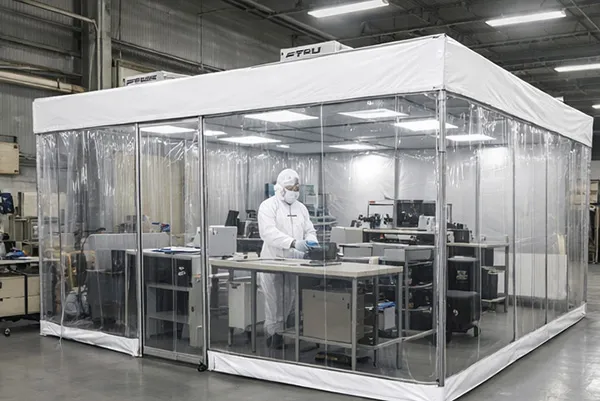
- 1. Soft-wall cleanrooms: Unlike hard-wall cleanrooms (made of stainless steel or color-coated steel panels), these utilize flexible materials such as PVC and polyester fiber for walls, supported by aluminum alloy frames. They enable rapid assembly, disassembly, and expansion, making them ideal for temporary clean zones and scenarios with fluctuating production demands. Cleanliness levels typically cover ISO 7-8, with some custom models achieving ISO 6.
- 2. Cost per square foot breakdown: This encompasses not only wall materials but the total sum of “primary materials + auxiliary materials + installation + supporting systems + hidden costs.” Primary materials refer to fabric wall coverings and frames, auxiliary materials include sealant strips and connectors, supporting systems comprise purification equipment such as FFUs and air showers, while hidden costs cover transportation, commissioning, and post-installation maintenance—elements often overlooked during procurement.
Is the cost per square foot of soft-wall cleanrooms always cheaper than hard-wall ones?
Answer: Not necessarily; it depends on the specific application. A basic soft-wall cleanroom (ISO Class 8, without complex purification systems) costs approximately $8–12 per square foot, which is indeed 30–40% lower than hard-wall cleanrooms ($15–25 per square foot). However, for higher cleanliness levels (ISO Class 6) or when custom integrated systems are required, soft walls necessitate enhanced sealing and purification configurations, pushing costs up to $12–18 per square foot. This narrows the gap with entry-level hard walls. Boben Modular Cleanroom Manufacturers provides detailed quotes based on the client’s cleanliness requirements to prevent cost overruns from overlapping configurations.
Does the “cost per square foot” in the quote include all hidden fees?
Answer: Most suppliers’ base quotes exclude hidden costs, which is a key pitfall to avoid during procurement. For instance, transportation fees, on-site installation and commissioning charges, and ancillary costs for equipment like FFUs are often billed separately, potentially increasing actual costs by 20%-30% over the quoted price. It is recommended to request suppliers to provide all-inclusive quotations during procurement. Boben Modular Cleanroom Manufacturers’ quotations clearly break down costs into main materials, auxiliary materials, installation, transportation, and other items, with no hidden surcharges. This facilitates accurate budgeting for the purchasing party.
Core Benefits of Choosing Soft-Wall Cleanrooms?
For businesses with limited budgets and flexible operational scenarios, optimizing soft-wall cleanroom costs delivers a win-win combination of cost-effectiveness and practicality:
- 1. Controllable initial investment: The base model costs significantly less than hard walls, making it ideal for small workshops and temporary clean areas. It eliminates the need for large upfront capital expenditures, reducing financial pressure for startups or expansion.
- 2. Low adjustment costs: Softwall modules can be rapidly disassembled and expanded. During layout modifications, material reuse exceeds 70%, with adjustment costs of just $2–3 per square foot—significantly lower than hardwall demolition and reconstruction costs ($8–10 per square foot).
- 3. Lower hidden costs: Installation cycles are 50% shorter than hard walls, saving 40% in labor costs. Smaller shipping volumes reduce freight costs by 30%-50% compared to hard wall materials, delivering savings for both rapid deployment and long-term operations.
Detailed Steps for Calculating and Controlling Cost Per Square Foot
- Step One: Define core requirements and lock in base costs. First determine the cleanliness grade (ISO 7/8 base models are cost-effective, while ISO 6 requires additional fees), usable area, and layout. Avoid excessive pursuit of high-end configurations that lead to cost wastage—for instance, standard laboratories only require ISO 8, not ISO 6 upgrades.
- Step Two: Break down cost components and compare supplier quotes. Request suppliers to itemize unit prices for main materials (e.g., soft wall fabric type, frame specifications), auxiliary materials, installation, and ancillary equipment. Focus on comparing quotes for core equipment like FFUs and air showers to avoid overpricing.
- Step Three: Negotiate all-inclusive quotes to avoid hidden costs. Explicitly require quotes to cover transportation, commissioning, training, and other expenses. Before signing contracts, stipulate “no hidden add-ons” and agree on material wastage rates (recommended under 3%) to minimize extra expenditures.
- Step Four: Optimize long-term costs by anticipating future needs. For instance, reserve expansion interfaces to prevent wasteful retrofits. Select low-maintenance soft wall materials (e.g., wear-resistant PVC) to reduce replacement costs. Boben Modular Cleanroom Manufacturers can provide material and configuration optimization recommendations to balance initial and long-term expenses.
- Step Five: Verify details during acceptance to ensure cost transparency. Cross-reference material specifications and installation procedures against the quotation to confirm no corners were cut. Document equipment parameters to establish a baseline for future maintenance, preventing additional repair costs due to quality issues.
Real-World Case Study: How Enterprises Control Soft Wall Cleanroom Costs
- Small Electronics Component Workshop (ISO Class 8, 500 sq ft).This workshop utilizes a basic soft-wall cleanroom optimized by Boben Modular Cleanroom Manufacturers, achieving a cost of $9.50 per square foot. The total budget is $4,750, representing approximately 35% savings compared to a hard-wall cleanroom of the same size (estimated at $7,300). Installation was completed in just 3 days, saving $2,000 in labor costs. When capacity adjustments later required a 200-square-foot expansion, reuse of existing materials kept additional costs to only $1,800. Overall cost control significantly exceeded expectations.
- Biological Laboratory (ISO Class 7, 300 sq ft).The laboratory requires both cleanliness and flexibility, opting for a custom soft-wall cleanroom at $13 per square foot, totaling $3,900. The supplier provided a fully inclusive quote with no hidden fees. Subsequent replacement of partial soft wall fabric incurs only $2.50 per square foot in maintenance costs, using environmentally compliant materials that meet laboratory requirements. Compared to equivalent hard-wall solutions, this design reduces initial investment by 40% and saves approximately $800 annually in ongoing maintenance expenses.
The core principle for cost per square foot in soft-wall cleanrooms is “precision configuration + transparent accounting,” avoiding blind pursuit of low prices or being entangled by hidden costs. Leveraging expertise in modular design, Boben Modular Cleanroom Manufacturers optimizes configurations based on enterprise scenarios. This ensures cleanliness while keeping costs within reasonable limits, maximizing cost-effectiveness.