Get a quoate
ISO Cleanroom Classification & Air Change Rates: 2026 Guide
Published : 2026-03-02In cleanroom facilities, cleanrooms are categorized into nine grades from ISO 1 to ISO 9 based on the production requirements of different industries. Significant differences exist in the structural layout of clean air conditioning systems and airflow organization patterns corresponding to each grade, directly impacting the particle control capability of the production environment. The following section provides a detailed analysis of the implementation methods, core structural requirements, and air change rate standards for each ISO cleanliness grade, based on industry operational standards. This analysis serves as a practical reference for cleanroom design and construction.
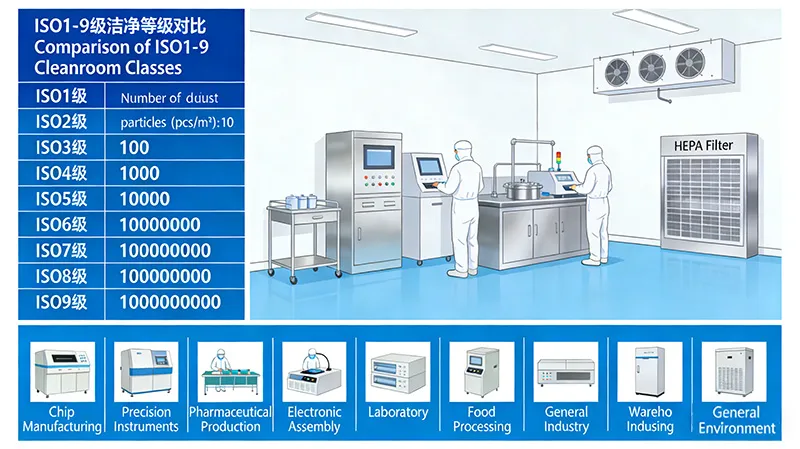
I. Core Design and Application Requirements for Each ISO Cleanroom Class
Requirements for airflow design, equipment configuration, and structural sealing in ISO Class 1-9 cleanrooms progressively relax as the grade decreases. The protection standards for core process areas remain the design priority. The specific implementation forms and typical application scenarios for different grades are shown in the table below:
| ISO Cleanliness Class | Airflow Design Configuration | Core Equipment Configuration Requirements | Structural and Sealing Requirements | Typical Application Scenarios |
| Levels 1-4 (Level 100 and above) | Unidirectional laminar flow (vertical / horizontal), piston-type flow propulsion | FFU arrays are fully deployed with nearly 100% coverage; the floor features high-perforation grid flooring / fully enclosed return air ducts. | The building envelope features a fully airtight seal; walls and ceilings transition seamlessly with curved edges, eliminating any dead corners. | Core areas of lithography machines, assembly of aerospace precision components, sterile pharmaceutical filling |
| Level 5 (Class 100) | Unidirectional laminar flow, vertical laminar flow velocity 0.36–0.45 m/s | FFUs are densely arranged above critical work areas, with appropriately reduced density around the periphery; Supported by a raised floor return air system. | Key area airtight sealing; mandatory installation of airlock chambers and air showers. | Semiconductor wafer manufacturing, biosafety cabinet operation, cardiac operating room |
| Class 6 (Class 1000) | Unidirectional Flow + Non-Unidirectional Flow Hybrid Design | Core Zone Laminar Flow Hood / Local FFU Protection, FFU Coverage 25%-50%; Auxiliary Zone High-Efficiency Air Supply Diffusers + Return Air Columns | Completely separate pedestrian and cargo flows with multi-level buffer zones; implement sealed treatment in core areas. | LCD panel assembly, microelectronics packaging, vaccine production |
| Level 7-8 (10,000 to 100,000) | Non-unidirectional turbulent flow, upward supply and downward return airflow organization | AHU systems primarily deliver centralized airflow, with FFUs installed at key locations in limited quantities; high-efficiency air diffusers are uniformly distributed throughout the ceiling. | Return air vents are installed at the lower section of the side walls; Color-coated steel panels / epoxy resin-coated walls, with relaxed requirements for joint sealing. | Production of conventional pharmaceutical preparations, medical device packaging, and high-cleanliness food filling |
| Level 9 | Standard air conditioning ductwork, simplified filtration design | Central air conditioning systems shall be retrofitted with medium-efficiency filters; no FFU configuration is required. | Basic dust-proofing only, no strict sealing requirements | Cleanroom raw material staging, product outer packaging, auxiliary functional areas |
II. Core Standard for Air Changes per Hour in ISO Cleanroom Classifications
Air change rate serves as the core performance metric for cleanroom ventilation systems, directly determining the dilution and exhaust capacity of airborne contaminants. This value decreases in a stepwise manner as ISO cleanliness grades decrease and requires dynamic adjustment based on actual facility conditions and production status. The industry-standard baseline air change rate and requirements for special operating conditions are outlined in the table below:
| ISO Cleanliness Class | Basic Air Change Rate (times/hour) | Special Operating Condition Adjustment Requirements |
| Level 3-4 | 300-600 | Extremely sensitive process areas may be upgraded as needed; ceiling heights exceeding 4 meters shall be recalculated based on actual volume. |
| Level 5 | ≥240 | Dynamic production requires a 30%-50% increase; for ceiling heights exceeding 4 meters, recalculate based on actual volume. |
| Level 6 | 100–300 | Core process areas may be appropriately increased; ceiling heights exceeding 4 meters shall be recalculated based on actual volume. |
| Level 7 | 25-50 | Dynamic production requires a 30%-50% increase; For ceiling heights exceeding 4 meters, recalculate based on actual volume. |
| Level 8 | 15-25 | Dynamic production requires a 30%-50% increase; for ceiling heights exceeding 4 meters, recalculate based on actual volume. |
| Level 9 | 10-20 | No dynamic production additional elevation requirements; minor adjustments as needed for ceiling heights exceeding 4 meters. |
Key Considerations:
- The air change rates specified above are based on static testing standards. During dynamic production operations, additional particulate contaminants are generated due to personnel activities and equipment operation. Consequently, the required air change rate must exceed the static standard by 30%-50% to ensure stable compliance with cleanliness standards throughout production.
- Air change calculations are based on standard factory floor heights. If actual cleanroom ceiling heights exceed 4 meters, fixed air change standards should be abandoned. Supply air volume must be recalculated based on actual space volume to prevent insufficient air changes in localized areas due to excessive ceiling height.
- Core process zones may moderately exceed the baseline air change rate, while auxiliary areas may be designed to the lower end of the standard range. This achieves “targeted protection and demand-based design,” balancing cleanliness requirements with energy consumption control.
Overall, the core principle of ISO cleanroom classification design is “aligning grades with requirements while controlling standards in detail.” From airflow patterns and equipment configuration to air changes per hour, customized design must be tailored to industry-specific production characteristics and process sensitivity. This approach ensures compliance with cleanliness requirements while avoiding energy consumption and cost wastage caused by over-engineering.