Get a quoate
How to Choose the Right Cleanroom Air Filter?
Published : 2026-03-01As semiconductor technology migrates toward smaller line widths, components have become increasingly sensitive to contamination and defects. From raw silica to the finished chip, a wafer undergoes over 100 processes spanning more than a month. Any pollutant introduced at any stage can cause irreversible damage. In the coming years, the semiconductor industry faces multifaceted challenges in contamination control.
Industries highly sensitive to environmental pollutants—such as semiconductor manufacturing, biotechnology, precision mechanics, pharmaceuticals, and hospital operating rooms—rely on controlled environments. Semiconductors, in particular, require rigorous control over temperature, humidity, and cleanliness. Parameters must be maintained within strict tolerances to prevent process interference. Sources of contamination, including dust, airborne microorganisms, suspended particulates, and volatile organic compounds (VOCs), enter the workspace through external infiltration or internal generation. Cleanroom air filtration is the core mechanism for managing air quality, intercepting pollutants at the source to ensure production environments meet global standards.
The Role of Fan Filter Units (FFU) in Precision Manufacturing
The Fan Filter Unit (FFU) is a critical component designed to maintain a controlled, contaminant-free atmosphere. Typically composed of a fan, motor, and a High-Efficiency Particulate Air (HEPA) or Ultra-Low Penetration Air (ULPA) filter, these units play a pivotal role in removing airborne particles.
The core function of a fan filter unit (FFU) is to protect sensitive devices during the fabrication process. In semiconductor production, even microscopic contaminants directly impact product quality and yield rates. As technological progress drives the demand for ultra-clean production spaces, the FFU has become indispensable for industries prioritizing precision and strict adherence to cleanliness standards.
Core Performance Metrics and Industry Standards for HEPA Filters in Cleanrooms
| Performance Metric | Industry Definition / Standard Requirement | Remarks |
| Filter Efficiency | Particle removal efficiency ≥85% for 0.3μm particles (Minimum standard for European HEPA certification) | Ultra-High Efficiency Particulate Air (ULPA) Filters: Efficiency ≥99.999% for 0.12μm Particles |
| Initial-Final Resistance Ratio | Final resistance is 2–4 times initial resistance Standard selection value for conventional | Values selected for conventional design; may be fine-tuned based on cleanroom operating conditions |
| Rated Airflow | Air Volume Flow Selected for Filter Element Testing | Must Match FFU Fan Rated Airflow |
| Dust Holding Capacity | The weight of test dust retained by the filter under specified test conditions | A key criterion for determining when to replace the filter |
Understanding Filtration Mechanisms
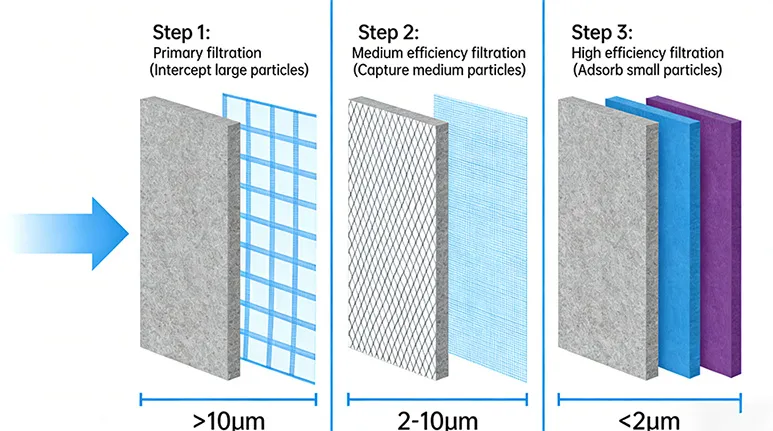
Air filter mechanisms primarily include Inertial Impaction, Diffusion, Interception, Sieving, and Adsorption. Different principles dominate depending on the particle size:
- Inertial Impaction: Larger dust particles travel with inertia in the airflow. When air swerves around a fiber, larger particles fail to change direction fast enough and collide directly with the fiber. The larger the particle, the stronger the inertial force and the higher the filtration efficiency.
- Diffusion (Brownian Motion): Particles smaller than 1-micron particles do not move with the airflow but instead undergo random motion due to collisions with air molecules. If they strike filter fibers, they are captured. Smaller particles exhibit greater diffusivity, thereby increasing collision and capture probabilities.
Consequently, particles with a diameter of 0.1 to 0.3 micrometers represent the “Most Penetrating Particle Size” (MPPS) and are the most difficult to remove. This range serves as the core benchmark for HEPA filters for cleanrooms. European standards dictate that a filter must achieve a purification efficiency of at least 85% for 0.3-micrometer particles to be certified as HEPA.
Key Performance Indicators (KPIs) for Air Filters
When evaluating air filter performance, four indicators are paramount:
- Rated Airflow: The volume of air flow the filter is designed to handle under test conditions.
- Resistance (Pressure Drop): The pressure difference between the upstream and downstream sides. This is divided into Initial Resistance (new filter) and Final Resistance (limit for replacement). Typically, final resistance is set at 2 to 4 times the initial resistance.
- Efficiency: The ratio of dust captured by the filter to the amount of dust in the unfiltered air.
- Dust-Holding Capacity: The total weight of synthetic dust a filter can retain before reaching final resistance under specific test conditions.
Effectively reducing resistance enhances filtration efficiency and extends the filter’s service life, thereby lowering production costs. Methods to reduce resistance include selecting low-resistance media, optimizing manufacturing processes, reducing face velocity, and increasing the filtration area. Research indicates that increasing the filtration area by 50% can extend service life by 70%–80%; doubling the area can nearly triple the lifespan.
Customized Solutions for Advanced Processes
Cleanroom air filters are highly diverse. Selecting the right unit requires a rigorous evaluation of filter media, frame materials, and sealing methods, while ensuring compatibility with the Fan Filter Unit.
Boben provides a wide range of primary, medium, and high-efficiency air filters for advanced cleanrooms. Our media options include glass fiber and synthetic fibers (such as PP, PP/PET composites, and PTFE). Furthermore, Boben’s R&D team can customize filters based on your existing or planned FFU installations, offering flexible choices in frame materials, membrane types, and dimensions.
In the semiconductor industry, where suspended particulates and gaseous pollutants must be strictly controlled, a reliable filtration system is the only guarantee of air cleanliness. Boben is deeply rooted in semiconductor cleanroom filtration, providing high-value solutions that precisely satisfy the requirements of different