Get a quoate
How to Build a Cleanroom? A Complete Guide from Planning to Commissioning
Published : 2025-12-22Building cleanrooms is a critical infrastructure project for high-end manufacturing enterprises in electronics, healthcare, food processing, and other sectors. Many companies encounter delays, cost overruns, or even failed factory inspections during their first attempts due to unclear processes, mismatched parameters, and incorrect equipment selection. In reality, cleanroom construction follows well-defined procedural standards, with the core principle being “define requirements first, then select the right solution.” The emergence of modular cleanrooms has made the construction process more efficient and flexible, making them the preferred choice for an increasing number of companies. Below, we break down the complete steps of cleanroom construction from a practical operational perspective to help you avoid unnecessary detours.

1. Initial Planning: Defining Core Requirements
The first step is to clarify your specific needs, which dictates the design and cost-control strategy.
Cleanliness Class: Determine the required ISO or industry-specific grade.
- Food Processing: Typically ISO 8 (Class 100,000).
- Electronics Packaging: ISO 7 (Class 10,000).
- Semiconductor Manufacturing: ISO 5 (Class 100).
Functional Zoning: Define the layout, including production areas, buffer zones, and testing labs. For example, medical facilities require isolated sterile zones.
Compliance Standards: Identify the certification needed, such as GMP (Medical), SC (Food), or ISO 14644 (Electronics).
Pro Tip: If you require rapid deployment, operate in a rented facility, or expect future capacity changes, Modular Cleanrooms are highly recommended due to their flexibility and portability.
2. Design Phase: Traditional vs. Modular Solutions
Choosing the right construction methodology is the most critical decision in the design phase.
| Feature | Traditional Civil Construction | Modular Cleanroom |
| Design Cycle | 30–60 Days | 10–20 Days |
| Best Use Case | Permanent facilities, ultra-large scale | Rapid startup, rented space, mid-sized labs |
| Flexibility | Difficult to modify or move | Easy to expand, reconfigure, or relocate |
| Integration | Custom-built on-site | Factory-prefabricated components |
Key System Design Elements:
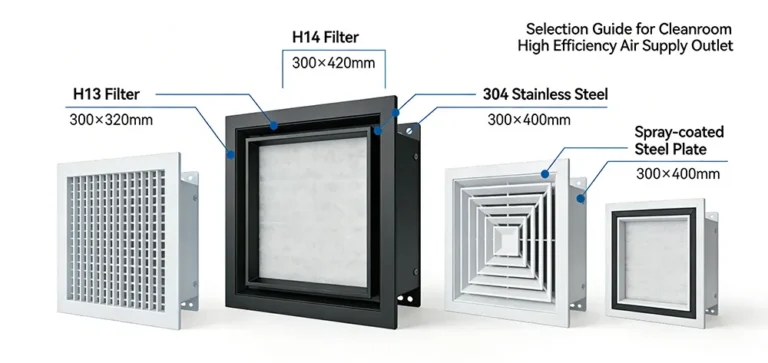
- Air Purification: HEPA filter selection and placement.
- Environmental Control: Precision HVAC for temperature and humidity.
- Pressure Control: Maintaining a positive pressure gradient (Typically ≥5 pascals).
3. Construction & Installation: Quality and Precision
Success in this phase relies on three pillars: Sealing, Cleanliness, and System Integration.
- Material Installation: Walls, floors, and ceilings must be non-shedding and smooth (e.g., Sandwich panels and Epoxy flooring). Modular cleanrooms offer superior sealing because components are pre-fitted in the factory.
- System Integration: Install HVAC, electrical, and filtration systems. In modular setups, these are often “plug-and-play,” reducing on-site labor by over 60%. A 200 m² modular project can often be completed in 15–30 days.
- Site Management: Strict “Clean Construction” protocols must be followed. Workers must wear cleanroom attire, and waste must be removed immediately to prevent cross-contamination.
4. Testing & Commissioning: Ensuring Compliance
Before production begins, the facility must pass rigorous testing:
- Particle Counting: Verify that the particle count (e.g., ≥0.5 microns) meets the target ISO class.
- Microbiological Testing: (For Food/Med) Testing for planktonic and sedimentation bacteria to meet GMP or SC standards.
- Stress Test: Running the system for 24–48 hours to ensure temperature, humidity, and pressure remain stable.
- Certification: Submitting final reports for official regulatory approval.
5. Summary and Key Recommendations
Selecting the right partner is the ultimate safeguard. As a modular cleanroom manufacturer, Boben offers turnkey “design-build-validate” services.
Thanks to standardized manufacturing processes, modular cleanrooms achieve a 30% higher first-time audit pass rate than traditional construction. For companies prioritizing efficiency and adaptability, modular solutions represent the standard choice for modern industries.