Get a quoate
Air Shower vs. Airlock vs. Buffer Room: Key Differences Explained
Published : 2026-02-23Air showers (also known as air shower doors, cleanroom entry systems, or dust baths) are mainly composed of fans, HEPA filters, control circuits, and cabinets. As essential purification equipment at a cleanroom entrance, an air shower’s core function is to remove dust attached to personnel or materials through high-velocity air jets. As long as the air velocity meets the standard, it effectively blasts away most surface particles—but this is only one of its functions.
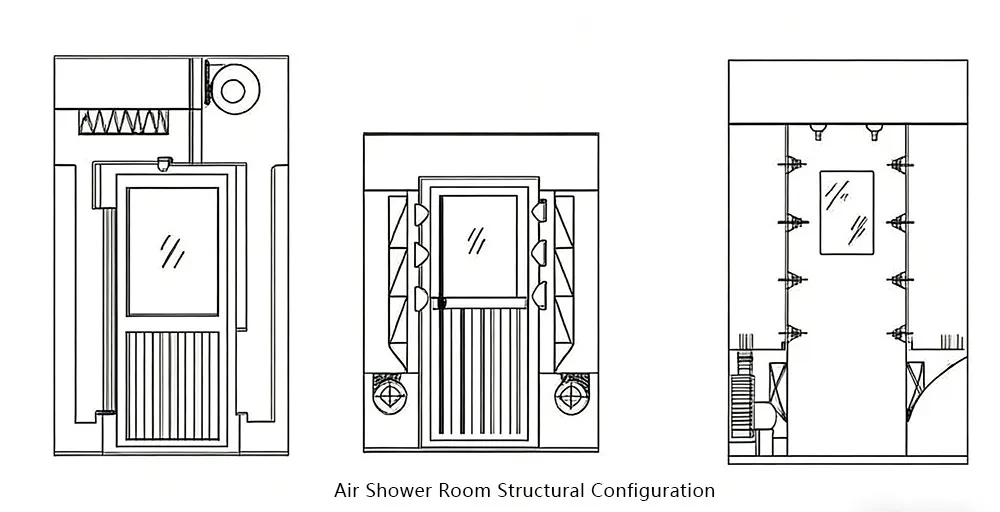
The most critical role of an air shower is acting as an effective physical barrier isolating the cleanroom from the outside world. This highlights the core difference between it and buffer rooms or airlocks: Air showers feature a built-in, active air-blowing and filtration system, whereas the latter two do not. In actual cleanroom engineering, Boben Modular Cleanroom Manufacturers precisely configures these three types of equipment based on the client’s cleanliness class requirements to ensure the facility passes all environmental standards.
- The Buffer Room
The structure of a buffer room is generally similar to an air shower, consisting mainly of inner and outer cabinets with similar dimensions. The core difference is that it lacks an active blowing function, meaning it does not require the control systems, HEPA filters, or fans found in an air shower.
A buffer room is equipped with an electronic interlock and serves as a mandatory passage for personnel or materials moving from a non-clean area to a clean area. Its air pressure gradually increases from the outside (non-clean area) to the inside (clean area).
A Buffer Room has two main purposes:
- Airflow Blockage: It prevents air from the non-clean area from rushing directly into the cleanroom. Having this physical buffer space greatly reduces contamination risks.
- Self-Purification Staging: When personnel or materials enter from a non-clean area, they can be temporarily “staged” in the buffer room to allow particles to settle (especially useful for material transfer) before entering the clean zone. This is a critical design detail that Boben Modular Cleanroom Manufacturers prioritizes in facility layouts.
2.The Airlock
An airlock is a buffer space set up specifically to maintain air cleanliness and positive pressure control within the cleanroom. It is typically installed between two clean areas of different cleanliness levels, or between a clean and non-clean area.
Its core purpose is to prevent cross-contamination between different environments. An airlock is generally maintained at a negative pressure relative to the adjacent functional rooms and utilizes a full-exhaust design. It is equipped with two doors that cannot be opened simultaneously, thereby isolating the air of two different environments. Airlocks are categorized into air-supply and non-air-supply types; strict biological cleanrooms always utilize airlocks with purified HVAC supply.
3.Airlock vs. Buffer Room: A Direct Comparison
Similarities:
- Both are designed to separate two areas and prevent direct airflow connection.
- Both have supply/exhaust air capabilities (often utilizing full exhaust).
- Both feature doors with electronic interlocks (they cannot be opened at the same time).
- Both provide a space for self-purification.
Core Differences:
- Airlock (Bi-directional): Generally used to separate two different clean zones. It maintains a negative pressure relative to both adjacent areas. Its main role is preventing cross-contamination between two clean environments.
- Buffer Room (Uni-directional): Used strictly between a non-clean area and a clean area. It maintains a positive pressure relative to the non-clean area and a negative pressure relative to the clean area. Its main role is solely to prevent the non-clean area from contaminating the clean area.
Boben Modular Cleanroom Manufacturers reminds you: Correctly distinguishing the functions and application scenarios of these three systems is the key to ensuring your cleanroom project meets regulatory standards while keeping long-term maintenance costs low.