Get a quoate
Cost-Effective Temporary Cleanroom Tents | Fast Setup for Laboratories & Manufacturing Workshops
Published : 2026-03-18When many clients first reach out to us, they usually have a similar concern:It’s not that they don’t need a cleanroom — they’re just wondering if there’s a more flexible, less heavy approach.
Traditional cleanrooms are reliable, no doubt. But the long construction time and high upfront investment can feel excessive, especially for temporary projects or production line adjustments.
That’s exactly why, in recent years, more and more companies are turning to a more flexible solution — temporary cleanroom tents.
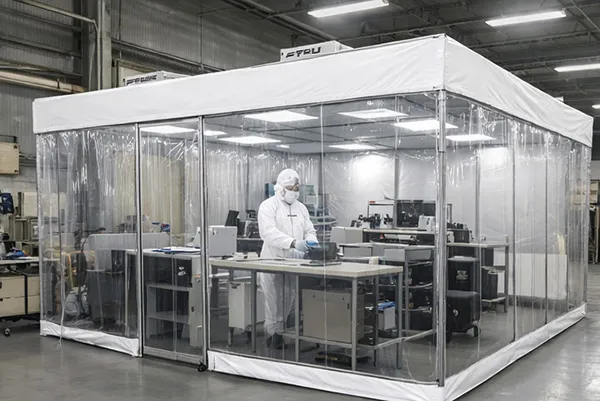
What is it, really? It’s simpler than you might think
At its core, a temporary cleanroom tent is just a way to create a controlled clean environment using a modular structure.No civil construction. No need to modify your existing facility.
It’s mainly built from a few key components:
- Frame structure (typically aluminum profiles, sometimes stainless steel)
- Enclosure materials (PVC curtains are common, often anti-static)
- Top-mounted FFU (fan filter units) — this is the critical part
Some clients initially worry that “temporary” means unstable or unreliable.But in practice, with proper configuration, achieving ISO Class 7 — or even Class 5 — is absolutely feasible.
Why do many factories end up preferring this solution?
From our experience, the reasons are actually quite straightforward.
1.It’s not just cheaper — it’s significantly cheaper
In many cases, the cost difference isn’t marginal. We’re often talking about 30% to 60% savings, especially when you only need a localized clean area instead of renovating an entire facility.
2.You save a lot of time — and sometimes that matters more than cost
Traditional cleanrooms involve design, construction, and validation — the timeline is hard to shorten.With modular cleanroom tents, once the plan is confirmed, installation is mostly assembly work.
In many cases, it can be up and running within a couple of days.For clients working against tight production deadlines, this can be a decisive factor.
3.Once used, it often gets reused elsewhere
This is something we see quite often.
For example:
- Initially installed at one workstation
- Later needed on another production line
- Then simply dismantled and reinstalled
A traditional cleanroom is a fixed asset.This, on the other hand, behaves more like a tool.
4.It’s not just “temporary” — it’s a practical first step
Some clients do plan to build a permanent cleanroom eventually, but their requirements aren’t fully defined yet.In these cases, they prefer to start with a cleanroom tent, get production going, and then make a more informed long-term decision later.
Where is it typically used?
Instead of listing industries, it’s more helpful to look at actual use cases:
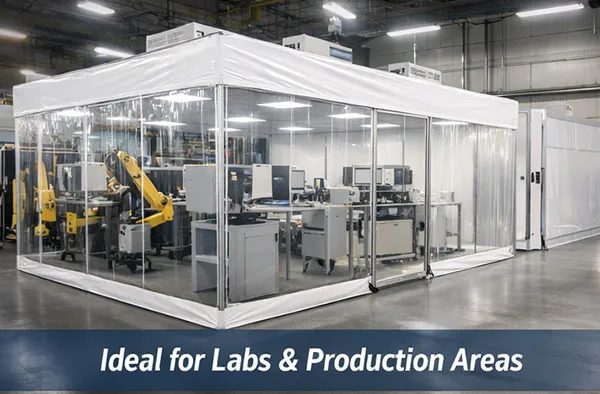
- Creating temporary clean zones within laboratories
- Upgrading specific areas inside existing workshops (without major renovation)
- Supporting pilot production or new product trials
- Packaging and inspection areas with moderate cleanliness requirements
One more common scenario:
👉 When the existing cleanroom capacity is no longer sufficient, this is often used as a quick extension.
What should you pay attention to when choosing a setup?
Rather than going too technical, here are a few practical points that are often overlooked:
FFU quantity and layout
More isn’t always better. It needs to match the space, otherwise you either overspend or fail to achieve the desired cleanliness.
Enclosure materials
If anti-static performance is required, it’s best to confirm this early — it’s harder to adjust later.
Height design
Too low affects operation, too high increases cost. It should be based on actual usage needs.
Future expansion
If there’s a chance you’ll need to expand later, it’s worth planning for it from the beginning.
Installation is usually easier than expected
In many of our projects, clients handle the installation themselves.The process is fairly straightforward:
- Confirm dimensions and layout
- Pre-fabrication at the factory
- On-site assembly based on drawings
- Power connection and FFU setup
With basic hands-on ability, it’s quite manageable. Of course, technical support can be arranged if needed.
Yes — that’s one of its main advantages.
It mainly depends on filter maintenance. Regular replacement keeps it stable.
It can be used long-term, but for highly regulated production environments, requirements should be evaluated case by case.
If your situation involves:
- Needing a solution quickly
- Wanting to control upfront investment
- Dealing with uncertain or evolving requirements
Then a temporary cleanroom tent is a very practical option. However, for large-scale, long-term, and strictly regulated production environments, it’s still advisable to plan a permanent cleanroom from the start.