Get a quoate
Cleanroom HEPA Box Selection Guide 2026 | Sizing & Specs
Published : 2026-02-25In cleanroom systems, high-efficiency air diffusers may be compact in size but directly impact cleanliness levels, operational energy consumption, and long-term maintenance costs. Many project managers and procurement personnel focus solely on dimensions and price during selection, overlooking critical parameters such as airflow volume, filtration efficiency, sealing methods, and installation environments. This often leads to issues like substandard purification, excessive energy consumption, and equipment failures. Drawing on years of cleanroom project experience, I will explain the correct selection method for high-efficiency air diffusers in a simple and clear manner.
“First and foremost, it is crucial to understand that HEPA terminal filter modules (HEPA boxes) are not one-size-fits-all standard parts. They must be precisely matched according to your required cleanliness class, airflow capacity, and specific installation conditions. Many clients who purchase and install these units without proper calculation often face severe issues later, such as failed particle counts, unstable pressure differentials, and air leakage. Ultimately, the cost of project rework and failed compliance audits is far higher than the initial price of the equipment itself.”
Boben Cleanroom Manufacturer consistently adheres to the principle of “calculate first, select later” in projects to ensure system stability and reliability.
I. Selecting Filter Efficiency Based on Cleanroom Class
Filtration efficiency is the most critical metric for high-efficiency air diffusers:
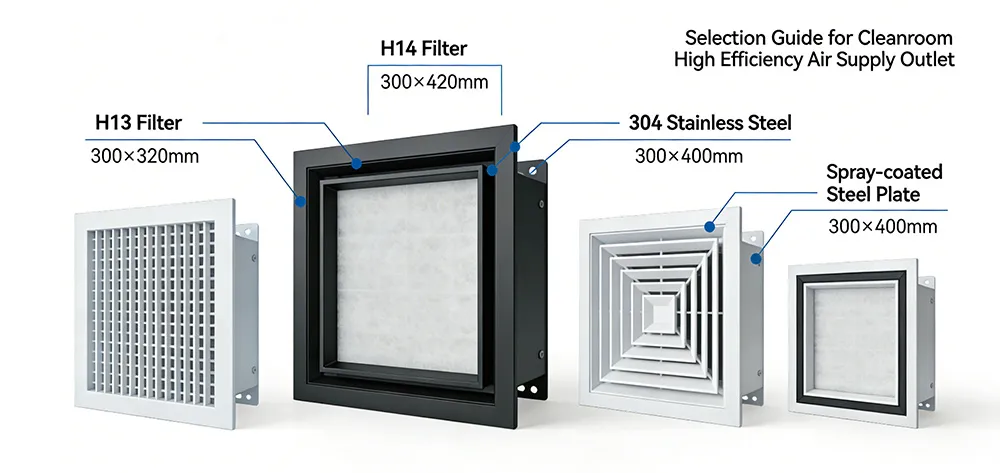
- Class 10,000 and Class 100,000 cleanrooms: H13 high-efficiency filters are recommended, with ≥99.97% filtration efficiency for 0.3μm particles. Suitable for electronics, food processing, and packaging facilities.
- Class 1,000 and Class 100 Cleanrooms: Recommended to use H14 or ULPA ultra-high-efficiency filters with ≥99.995% filtration efficiency. Suitable for pharmaceutical, semiconductor, and precision electronics industries.
- Biological Laboratories and Operating Rooms: Prioritize models with PAO leak detection ports for convenient acceptance testing and routine inspections.
Boben Cleanroom Manufacturer will precisely match filtration efficiency to your target cleanliness level, avoiding waste from over-specification or non-compliance from under-specification.
II. Selecting Specifications and Dimensions Based on Airflow and Air Exchange Rate
Insufficient airflow can lead to unstable cleanliness levels, while excessive airflow generates noise, increases energy consumption, and disrupts airflow patterns.
Standard calculation steps:
- Calculate total room air volume: Room volume × Air changes per hour
- Determine number of supply air outlets and airflow per unit
- Select standard dimensions: e.g., 484×484, 630×630, 1175×570, etc.
Standard Class 10,000 cleanrooms typically utilize single-unit airflow rates of 800–1200 m³/h. Maintaining an outlet air velocity of 0.3–0.6 m/s ensures optimal stability, guaranteeing purification effectiveness without disrupting production operations.
Ⅲ. Selecting the Structure Based on Installation and Maintenance Requirements
The structural design directly impacts installation, sealing integrity, and filter replacement:
- Top-mounted / Ceiling-mounted: Most widely used, provides uniform airflow, suitable for new workshops.
- Side-mounted: Suitable for workshops with limited ceiling space or retrofitting existing facilities.
- Sealing Method:Standard workshops: Mechanical seal, cost-effective.
- High-grade cleanrooms: Liquid-trough seal, zero leakage, meets GMP requirements.
- With/Without Control Valve: Recommended for workshops requiring differential pressure control and zoned airflow regulation.
IV. Selecting Materials Based on Workshop Environment
Different industry environments have distinct material requirements:
- Electronics factories, anti-static zones: Anodized aluminum + anti-static dissipative panels.
- Pharmaceutical, food processing, humid environments: 304 stainless steel, corrosion-resistant and easy to clean.
- Standard cleanrooms: Powder-coated steel panels, economical and durable.
V. The 3 Most Common Mistakes in Equipment Selection
- Focusing on appearance over efficiency: H13 and H14 filters have minimal price differences, yet their cleanliness performance varies significantly.
- Incorrect airflow calculations: Insufficient air outlets create dead zones in clean areas, leading to particle count exceedances.
- Inadequate sealing: Air leaks and unstable pressure differentials ultimately result in failed inspections.
HEPA Box diffusers are critical terminal devices in cleanroom systems. Selecting the right model ensures stable purification, lower energy consumption, and simpler maintenance.
Boben Cleanroom Manufacturer offers complimentary airflow calculations, layout design, and model recommendations tailored to your workshop size, cleanliness requirements, and production processes. This prevents selection errors at the source, enabling more stable and energy-efficient cleanroom operation.