Get a quoate
Air Shower vs. Pass Box: Key Differences in Cleanroom Contamination Control
Published : 2026-02-24The Core Role and Detailed Differences Between Air Showers and Pass Box in Cleanrooms:
The core commonality between the two lies in preventing contamination and maintaining cleanroom environmental standards, both requiring compliance with regulatory standards such as GMP and ISO 14644. However, significant differences exist in their application scope, operating principles, and operational requirements. With years of expertise in cleanroom equipment R&D and implementation, combined with experience from thousands of cleanroom projects in the pharmaceutical and electronics industries, boben Cleanroom Manufacturer has identified the key similarities and differences between the two, as detailed below:
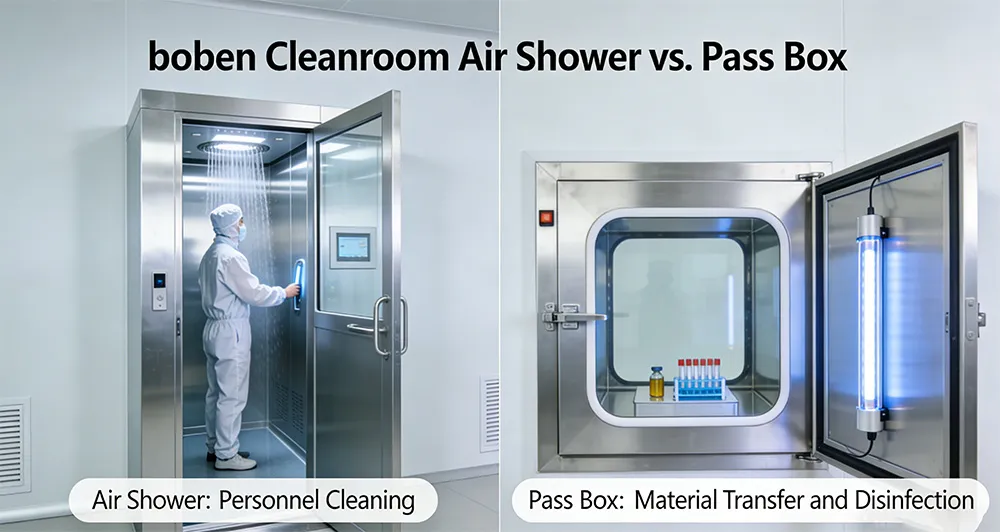
I. Common Features
- Structural Cross-Contamination Prevention: Both are equipped with dual-door interlock mechanisms, preventing simultaneous opening of both doors. This physically blocks direct airflow convection between clean and non-clean zones (or zones of different cleanliness levels), avoiding pressure differential imbalances and contaminant diffusion within clean areas.
- Consistent Regulatory and Management Requirements: Both must be integrated into the clean area equipment management system, maintaining comprehensive maintenance and calibration records, and undergoing regular audits. Daily cleaning requires dust-free, clean wipes for interior surfaces. Storing items inside the equipment is prohibited to prevent new contamination sources.
- Shared Maintenance and Calibration Principles:Both require periodic inspections of door seal integrity and functional component operation. Aging consumables (e.g., filters, UV lamps) must be replaced promptly to ensure continuous compliance with operational standards.
II. Core Differences Comparison
| Comparison Dimensions | Air Shower | Pass Box |
| Applicable to | Personnel, large material carriers (stainless steel carts, large containers, etc.) | Small materials, tools, and documents (e.g., sample bottles, reagent tubes, batch production records) are permitted. Personnel and large items are strictly prohibited. |
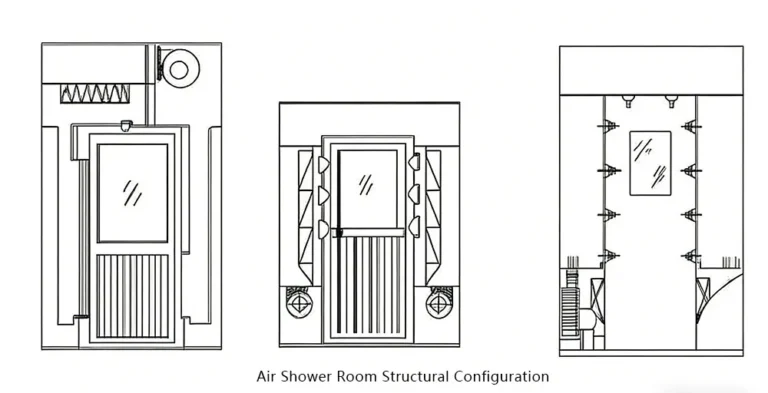
| Core Purification Principle | High-speed airflow blowdown + filtration, with HEPA-filtered airflow at ≥25 m/s to strip away dust particles/microbes. | Physical isolation + auxiliary disinfection (UV lamp), no active purification, only disrupts microbial DNA |
| Installation Location | Buffer room at the primary entry point for personnel/materials into the clean area, forming a three-stage isolation system (non-clean area → air shower → clean area) | Embedded partition walls between clean areas and non-clean areas (or areas of different cleanliness levels) require no additional buffer space. |
| Differential Pressure Requirements | The internal pressure differential is slightly lower than the clean area but higher than the non-clean area, requiring interlocking with the clean area pressure differential. | No additional differential pressure control; only matches the environmental parameters of the area where it is located. |
| Execute core processes | Close door → Infrared-triggered purge (15-30 seconds) → Purge complete → Unlock inner door | Place items → Close door → UV disinfection (15-30 minutes, with disinfection option) → Open door to retrieve items |
| Core Maintenance Points | Daily inspection of fans / sensors / interlocks; monthly calibration of purge air velocity and PAO leak detection for high-efficiency filters | Daily interlock checks / UV lamps, monthly calibration of UV irradiance (≥70μW/cm²) |
III. Additional Details on Differences
- Applicable to: Air showers accommodate the passage of large, bulk material carriers and are essential equipment for personnel entering high-grade cleanrooms. Pass-through chambers focus on transferring small items and serve as core components for precise material control within clean areas. Boben Cleanroom Manufacturer will precisely match the specifications and quantities of air showers and pass-through chambers based on the client’s cleanroom area and material types.
- Core Purification Principle: The air shower’s cyclical purification process reduces contaminants introduced by personnel or large carriers at the source, while the pass-through window’s UV disinfection targets only microorganisms without altering particle adhesion states. The inherent difference in their purification logic determines their irreplaceable roles in specific application scenarios.
- Installation and Operational Requirements: Adequate clearance space must be reserved for air shower installation to ensure full door opening and operational efficiency. Pass-through window installation requires matching wall opening dimensions. Boben Cleanroom Manufacturer offers on-site assessment services to customize pass-through window dimensions based on wall structures. We also provide guidance for air shower differential pressure interlock commissioning to ensure compliance with GMP requirements.
- Maintenance and Calibration Details: The replacement cycle for high-efficiency filters in air showers, calibration of airflow velocity, replacement of UV lamps in pass box (with a service life of 8,000 hours), and calibration of irradiation intensity must all be strictly performed according to schedule. Any oversight in these procedures may result in cleanroom environment conditions exceeding specified standards.
IV. Functional Complementarity
Air showers address the active purification of personnel and large material carriers, preventing the introduction of significant contaminants into clean areas. Pass-through chambers resolve the sterile transfer of small items, avoiding disruption to clean area pressure differentials and environmental stability caused by frequent door openings. Both are indispensable, collectively forming the contamination control system for personnel and material access within clean areas. In practical projects, optimal configuration based on cleanroom classification and personnel/material flow rates is essential to maximize contamination control effectiveness.
Summary:
- The core commonality between air showers and pass box is “preventing contamination and maintaining standards,” but they differ significantly in application targets, purification principles, and operational maintenance, requiring tailored configurations.
- The table clearly presents the key differences between the two, facilitating quick identification of selection criteria.
- Boben Cleanroom Manufacturer offers customized selection, installation, commissioning, and full-process maintenance services for air showers and pass-through chambers based on actual cleanroom scenarios, ensuring compliant equipment operation.