Get a quoate
Static vs Dynamic Pass Box in Pharma: Key Differences & Selection Guide
Published : 2026-01-13Essential Definitions of Static and Dynamic Transfer Boxes
In the material transfer process of pharmaceutical cleanrooms, pass boxes serve as indispensable “sterile barriers”—their core function is to prevent airflow exchange between areas of different cleanliness levels (such as Class D packaging zones and Class C preparation zones) during material transfer, thereby preventing contamination or cross-contamination. The fundamental difference between static and dynamic transfer boxes lies in whether they incorporate an “active purification airflow” function. This distinction directly determines their applicable scenarios and compliance requirements.
First, consider the static pass-through box: Essentially a “sealed isolation pass-through container,” it lacks an integrated clean air supply system, relying primarily on its airtight seal and interlocking mechanism to achieve isolation. Its operational logic is straightforward: After materials are placed inside, closing one door triggers the interlock mechanism to secure it. Materials can only be retrieved by opening the opposite door. This “physical barrier” prevents airflow exchange. Some premium models incorporate UV disinfection lamps for supplementary sterilization, but the core function remains “passive isolation.” When designing entry-level cleanrooms, boben Modular Cleanroom Manufacturers pairs them with appropriately sized static pass-through boxes tailored to low-risk material transfer requirements.
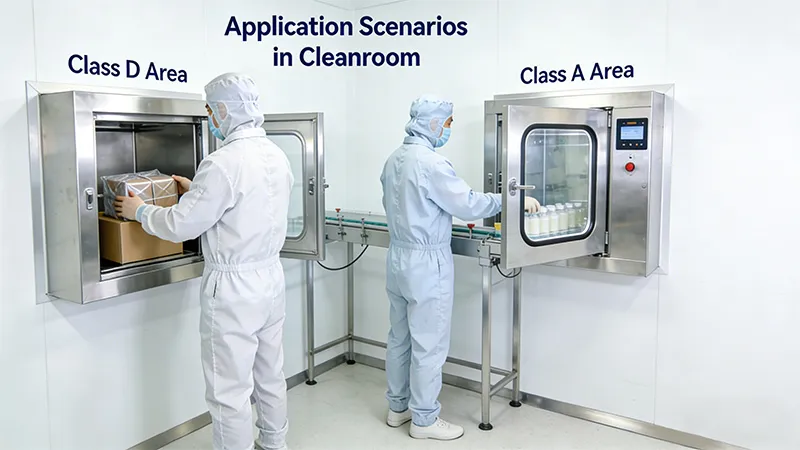
Now consider the dynamic transfer box: a composite device combining “active purification and isolation,” it incorporates a built-in HEPA filter (with a filtration efficiency ≥ 99.995%@0.3μm) and an air supply system. This setup generates a stable clean airflow within the chamber (typically achieving ISO Class 5 cleanliness). During material transfer, the purification system operates continuously to rapidly filter suspended particles and microorganisms within the chamber. Simultaneously, it maintains a slight positive pressure inside, further blocking the infiltration of external contaminated airflow. This achieves simultaneous “transfer + purification,” making it an active pollution control device.
To more clearly distinguish the core differences between the two, refer to the following comparison table:
| Comparison Dimensions | Static Pass-Through Box | Dynamic Pass-Through Box |
| Core Features | No active purification system; passive isolation | Built-in HEPA filter + air supply system; active purification |
| Purification Method | Physical isolation only, with optional UV disinfection as an auxiliary measure | Continuous clean airflow purification, achieving ISO Class 5 cleanliness inside the enclosure |
| Key Configuration | Sealed structure, interlocking device, optional UV lamp | HEPA filter, supply fan, micro-positive pressure monitoring, interlocking device |
| Isolation Principle | Blocking airflow exchange for passive contamination prevention | Clean airflow + slight positive pressure for active contamination prevention |
| Applicable Scenarios | Low-risk materials, transfer between same-level/lower-level cleanrooms | High-risk materials, transfer to higher-level cleanrooms |
| Cost Level | Low procurement and operational costs | High procurement and operational costs (approximately 2-3 times that of static systems) |
How should pharmaceutical production facilities be selected? Are there clear boundaries for the applicable scenarios of static and dynamic transfer boxes?
Answer: The core selection logic is “matching material risk level with cleanroom grade,” with clear boundaries. First, consider low-risk scenarios: When transferring non-active materials with no microbial contamination risk between different low-grade cleanrooms (e.g., transferring outer packaging materials or cleaning tools between Class D areas), a static transfer box suffices and offers better cost-effectiveness—provided its sealing integrity and interlock function remain operational. Next, examine high-risk scenarios: When transferring materials to higher-grade cleanrooms (e.g., transferring inner packaging materials or sterile raw materials to Class A/B aseptic filling areas) or materials with microbial contamination risks (e.g., traditional Chinese medicine extracts, bioactive materials), dynamic pass-through boxes are mandatory. This is because the passive isolation of static pass-through boxes cannot completely eliminate particles and microorganisms carried on material surfaces, potentially contaminating higher-grade areas and failing to meet GMP requirements for sterile barriers. boben Modular Cleanroom Manufacturers provides precise selection solutions based on clients’ material lists and cleanroom layouts, preventing compliance risks caused by improper selection.
Dynamic transfer boxes are significantly more expensive than static ones and require more complex maintenance. Is it really necessary to blindly opt for dynamic ones?
Answer: There’s absolutely no need to blindly pursue dynamic solutions—the key lies in “matching needs appropriately.” First, from a cost perspective, the procurement cost of dynamic transfer boxes is 2-3 times that of static ones. Additionally, they require regular replacement of HEPA filters and maintenance of the air delivery system, resulting in higher long-term operational costs. If the material risk is low, choosing dynamic solutions constitutes “overinvestment.” Second, from a compliance perspective, GMP mandates “reasonable risk control” rather than “the more advanced the equipment, the better.” Using dynamic systems in low-risk scenarios may actually increase contamination risks due to improper maintenance (e.g., delayed filter replacement). The correct approach is to first assess the “cleanliness level difference” and “material risk level” for material transfer, then select the appropriate type: use static for low-risk, same-level/lower-level transfers, and dynamic for high-risk, higher-level transfers. This approach meets compliance requirements while controlling costs.
Core Benefits of Selecting Static/Dynamic Transfer Boxes According to Standards
For pharmaceutical companies, selecting and utilizing pass boxes effectively not only ensures GMP compliance but also directly reduces production risks and enhances efficiency. First, it strengthens the aseptic barrier, preventing cross-contamination caused by material transfer and reducing batch wastage. One company suffered over a million yuan in losses when a batch was contaminated after transferring raw materials to a Class C area using a static pass box. Such issues can be entirely avoided by standardizing pass box selection. Second, it enhances transfer efficiency. The interlocking mechanisms on both types of pass-through chambers prevent operational errors like “both doors opening simultaneously.” The synchronized purification function of dynamic pass-through chambers eliminates the need for additional disinfection wait times after material entry, boosting circulation efficiency. Third, it reduces compliance audit risks. During regulatory inspections, the compatibility of pass-through chamber selection and maintenance records are key audit points. Proper selection ensures smooth audit passage. Fourth, it controls overall costs. Selecting models based on actual needs prevents overinvestment while reducing rework and scrap costs caused by contamination, resulting in greater long-term economic efficiency.
Selection and Usage Procedures for Static/Dynamic Pass Boxes in Pharmaceutical Manufacturing Facilities
- Define Transfer Requirements. Identify two core pieces of information: First, the “cleanliness level difference” being transferred (e.g., from non-clean areas to Class D, Class D to Class C, Class C to Class A, etc.); Second, the material risk level (e.g., whether sterile, containing microbial activity, or prone to generating airborne particles). Compile these into a detailed transfer requirements checklist.
- Precise Selection. Match types based on requirement lists: ① Low risk + same-level/lower-level transfer (e.g., D-D, non-clean-D): Select static pass-through boxes, focusing on sealing integrity and interlock reliability; UV disinfection can be added as needed. ② High-risk + high-level transfer (e.g., D-C, C-A/B): Select dynamic pass-through boxes, verifying HEPA filter efficiency, internal cleanliness grade (must meet ISO Class 5), and micro-positive pressure control capability. Prioritize products compatible with cleanroom systems. Pass-through boxes from boben Modular Cleanroom Manufacturers integrate seamlessly with modular cleanrooms, minimizing installation and compatibility issues.
- Standard installation. Installation locations must avoid dead zones in cleanroom airflow, ensuring that the pass-through box has “one side door facing the high-cleanliness area and the other side facing the low-cleanliness area.” For static pass-through boxes, inspect for airtightness (door seal strips must be intact). For dynamic pass-through boxes, ensure coordination between the air supply system and the cleanroom HVAC system to prevent airflow interference.
- Standard Operating Procedure. ① Static Transfer Box: Place materials inside → Close the feed door → Activate UV disinfection (if applicable) → After disinfection completes, open the discharge door from the opposite side to retrieve materials; close the door promptly after retrieval. ② Dynamic Pass-Through Chamber: Place materials → Close feed door → Activate purification system → Wait 3-5 minutes for purification cycle (ensuring chamber cleanliness) → Open discharge door to retrieve materials. After retrieval, maintain purification system operation for 3 minutes before closing door to prevent residual contamination.
- Regular Maintenance. ① Static Pass Box: Daily inspection of interlock functionality and integrity of sealing gaskets; weekly cleaning of interior walls; monthly verification of UV lamp intensity (if applicable). ② Dynamic Pass Box: In addition to the above checks, monthly monitoring of internal cleanliness; replacement of HEPA filters every 6-12 months; establishment of comprehensive maintenance and replacement records to ensure traceability.
Practical Application Results Case Study
- A biopharmaceutical company’s aseptic filling workshop (Class A area) previously used static pass-through boxes to transfer inner packaging materials, resulting in multiple instances of particle count exceeding standards. After switching to a dynamic pass-through box from boben Modular Cleanroom Manufacturers—equipped with an integrated H14 HEPA filter maintaining ISO Class 5 cleanliness and featuring micro-positive pressure monitoring—the particle exceedance rate during inner packaging transfer dropped from 3.2% to zero. The facility successfully passed EU GMP inspection, with sterile drug batch pass rates increasing to 99.9%.
- A chemical pharmaceutical company previously used dynamic transfer boxes for all transfer processes, resulting in high operational costs and inadequate maintenance in certain areas. After reassessing transfer requirements, low-risk outer packaging transfers (non-cleanroom to Class D) were switched to static transfer boxes, while high-risk raw material transfers (Class D to Class C) retained dynamic transfer boxes. Following this optimization, the company not only met GMP requirements but also reduced annual equipment procurement costs by 40% and operational maintenance expenses by 35%. Concurrently, transfer efficiency improved by 20%, achieving dual optimization in compliance and cost efficiency.
boben Modular Cleanroom Manufacturers excels in localized service responsiveness and GMP compliance expertise. Its project teams tailor pass-through chamber dimensions, interlocking logic, and automation interfaces based on clients’ production line cycle times, material dimensions, and sterilization methods—eliminating common mismatches between “standard components” and production lines. This “engineering mindset” delivers far greater industry value than merely selling equipment.