Get a quoate
4 Best Practices to Maintain Cleanroom GMP Standards Effectively
Published : 2026-01-18For pharmaceutical enterprises, maintaining cleanroom GMP standards is not a one-time event achieved during acceptance; it is a systemic task that spans the entire production lifecycle. Many pharmaceutical companies have fallen into the trap of finding it “easy to build, but hard to maintain.” This dilemma can lead to regulatory rectification notices in minor cases or, in severe cases, delays in product market entry. To ensure continuous compliance with GMP requirements, companies must focus on four core dimensions—Personnel, Equipment, Environment, and Processes—balancing regulatory compliance with operational practicality.
1.Personnel Management: The First Line of Defense
Personnel are the primary source of contamination and the most vulnerable link in maintaining GMP standards. Operational discipline directly impacts environmental cleanliness, requiring a closed-loop mechanism of “Training + Assessment + Supervision.” It is essential to conduct not only pre-job GMP training—clarifying details like personnel/material flow routes, gowning procedures, and hand disinfection—but also regular recurrent training and practical assessments to prevent operations from becoming a formality. For example, entry into Grade A/B clean zones must strictly enforce secondary gowning procedures and prohibit jewelry or unauthorized items. These details must be reinforced through on-site supervision and video surveillance to eliminate any “luck-pushing” mentality.
2.Equipment Maintenance: Ensuring Stability
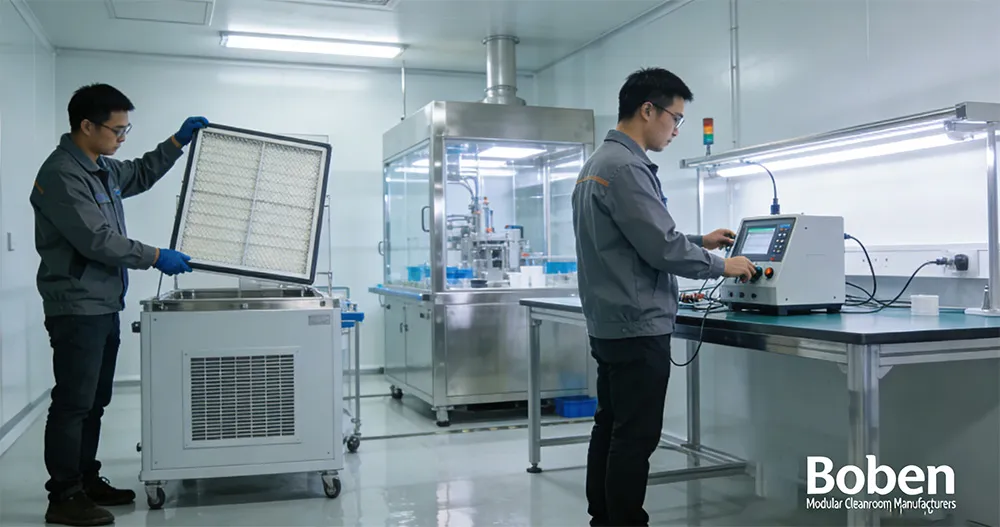
The stability of equipment operations directly determines whether cleanroom environmental parameters meet standards. Core equipment such as FFUs (Fan Filter Units), air showers, and pass boxes requires personalized maintenance logs rather than generic checklists. Boben Modular Cleanroom Manufacturers offers a distinct advantage here. Thanks to their standardized modular design, post-installation maintenance is significantly more convenient. For instance, their systems feature external HEPA filter replacement ports, allowing replacement cycles to be adjusted based on actual dust concentration without the need for large-scale module dismantling. This not only minimizes production downtime but also ensures continuous filtration efficiency. Simultaneously, critical components like motors and control systems must undergo regular inspection to record operating parameters, ensuring early detection of anomalies to avoid pressure differentials or air velocities deviating from GMP requirements.
3.Environmental Dynamic Monitoring: The Core Method
Cleanroom parameters such as temperature, humidity, airborne particles, and microbial limits must be managed through “Real-time monitoring + Regular calibration + Data traceability.” It is recommended to install online monitoring equipment in critical areas to implement tiered control for different ISO Class 5-8 zones, with data automatically retained for at least 3 years to meet regulatory traceability requirements. Boben Modular Cleanroom Manufacturers provides compatible intelligent monitoring modules that seamlessly integrate with the cleanroom structure. This assists enterprises in controlling environmental parameters in real-time and provides early warnings for abnormal fluctuations, preventing compliance risks like particle count excursions. Furthermore, regular third-party testing should be conducted to cross-verify with autonomous monitoring data, ensuring long-term stability in accordance with GMP and ISO 14644 standards.
4.Process Loop Management: The Guarantee
A robust maintenance system requires SOPs (Standard Operating Procedures) covering daily cleaning, disinfection, and emergency handling, clearly defining workflows, responsible personnel, and frequencies. Cleaning and disinfection tools must be segregated by cleanroom grade to prevent cross-contamination. Disinfection frequency should be adjusted based on production load—increasing during high-load periods. Additionally, a deviation handling mechanism must be established. If issues such as parameter excursions or operational errors occur, an investigation must be launched immediately to analyze the root cause, implement rectification, and assess the impact on product quality, resulting in a comprehensive deviation handling report.
| Maintenance Dimension | Core Maintenance Points | Recommended Frequency | Key Requirements of GMP |
| Personnel Management | Proper donning of cleanroom garments, hand sanitization, and adherence to personnel/material flow routes | Pre-employment training + monthly refresher training, with daily on-site supervision | No record of non-compliant operations; training records are traceable. |
| Equipment Operation and Maintenance | HEPA filter replacement, motor inspection, differential pressure/air velocity calibration | Replace filters every 6-12 months. Conduct daily equipment inspections and monthly calibrations. | Filtration efficiency ≥99.995%, with parameter fluctuations within the permissible range. |
| Environmental Monitoring | Temperature and humidity, particulate matter, microbial limit monitoring | Real-time online monitoring, with monthly third-party verification | Data retention ≥ 3 years, no exceedance anomalies |
| Process Management | Zone cleaning and disinfection, deviation handling, SOP execution | Daily cleaning and disinfection, immediate handling of deviations, and regular reviews. | No cross-contamination, deviation handling with closed-loop traceability |
Balancing Compliance and Economy
It is worth noting that maintaining GMP standards requires balancing “Compliance” and “Economic Efficiency.” Over-maintenance increases OPEX, while under-maintenance invites risk. Enterprises should optimize maintenance schemes based on specific production scenarios. For example, modular cleanrooms allow for targeted adjustments of purification parameters in local areas using flexible components, eliminating the need for whole-system adjustments.
In summary, maintaining cleanroom GMP standards requires discarding the mindset of “prioritizing construction over maintenance” and integrating compliance requirements into every operational detail. Selecting a partner like Boben Modular Cleanroom Manufacturers, who possesses both modular technology and regulatory experience, ensures a solid foundation during the construction phase and adaptive support during operations. This helps enterprises achieve long-term, stable implementation of GMP standards, building a solid firewall for pharmaceutical quality.